Monday, 29 July 2013

HOOK'S LAW OF STRESS & STRAIN

The generalized Hooke's Law can be used to predict the deformations caused in a given material by an arbitrary combination of stresses.

The linear relationship between stress and strain applies for   
Original Specimen


where:


E is the Young's Modulus
n is the Poisson Ratio


The generalized Hooke's Law also reveals that strain can exist without stress. For example, if the member is experiencing a load in the y-direction (which in turn causes a stress in the y-direction), the Hooke's Law shows that strain in the x-direction does not equal to zero. This is because as material is being pulled outward by the y-plane, the material in the x-plane moves inward to fill in the space once occupied, just like an elastic band becomes thinner as you try to pull it apart. In this situation, the x-plane does not have any external force acting on them but they experience a change in length. Therefore, it is valid to say that strain exist without stress in the x-plane.

NEWTON'S LAW OF COOLING


Newton's Law of Cooling states that the rate of change of the temperature of an object is proportional to the difference between its own temperature and the ambient temperature.

Where  is the rate of change of temperature of an object with respect to time t.
 is the ambient temperature and K is the experimental constant 
From intial condition,  ,  is obtained as follow

K can experimentally be found easily knowing that ,

VAPOUR COMPRESSION REFRIGERATION CYCLE

Vapor Compression Refrigeration Cycle

One of the applications that involves thermodynamic principles is the refrigerator. The figure below is a schematic diagram of the components found in a typical refrigerator.

The refrigerant enters the compressor as a slightly superheated vapor at a low pressure. It then leaves the compressor and enters the condenser as a vapor at some elevated pressure, where the refrigerant is condensed as a result of heat transfer to cooling water or to the surroundings. The refrigerant then leaves the condenser as a high-pressure liquid. The pressure of the liquid is decreased as it flows through the expansion valve and, as a result, some of the liquid flashes into vapor. The remaining liquid, now at a lower pressure, is vaporized in the evaporator as a result of heat transfer from the refrigerated space. This vapor then enters the compressor.
Vapor Compression Refrigeration Cycle

LAWS OF THERMODYNAMICS


Thermodynamics is the study of relationship between energy and entropy, which deals with heat and work. It is a set of theories that correlate macroscopic properties that we can measure (such as temperature, volume, and pressure) to energy and its capability to deliver work. A thermodynamic system is defined as a quantity of matter of fixed mass and identity. Everything external to the system is the surroundings and the system is separated from the surroundings by boundaries. Some thermodynamics applications include the design of:
  • air conditioners and refrigerators
  • turbo chargers and superchargers in automobile engines
  • steam turbines in power generation plants
  • jet engines used in aircraft

Zeroth Law of Thermodynamics

The zeroth law of thermodynamics states that when two bodies have equality of temperature with a third body, they in turn have equality of temperature with each other. All three bodies share a common property, which is the temperature. For example: one block of copper is brought into contact with a thermometer until equality of temperature is established, and is then removed. A second block of copper is brought into contact with the same thermometer. If there is no change in the mercury level of the thermometer during this process, it can be said that both blocks are in thermal equilibrium with the given thermometer.
First Law of Thermodynamics

The first law of thermodynamics states that, as a system undergoes a change of state, energy may cross the boundary as either heat or work, and each may be positive or negative. The net change in the energy of the system will be equal to the net energy that crosses the boundary of the system, which may change in the form of internal energy, kinetic energy, or potential energy. The first law of thermodynamics can be summarized in the equation:

Where:
 is the heat transferred to the system during the process 
 is the change in internal energy

 is the change in kinetic energy

 is the change in potential energy

 is the work done by the system during the process


Second Law of Thermodynamics

The second law defines the direction in which a specific thermal process can take place. The second law of thermodynamics states that it impossible to construct a device that operates in a cycle and produces no effect other than the transfer of heat from a cooler body to a hotter body. The second law of thermodynamics is sometimes called the law of entropy, as it introduces the important property called entropy. Entropy can be thought of as a measure of how close a system is to equilibrium; it can also be thought of as a measure of the disorder in the system.
Reversibility

A reversible process for a system is defined as a process that, once having taken place, can be reversed and leaves no change in either system or surroundings. The difference between a reversible and an irreversible process can be illustrated with the example below.
Suppose a gas under pressure is contained in a cylinder fitted with a piston. The piston is locked in place with a pin. If the pin is removed, the piston is raised and forced abruptly against the stopper. Work is done by the system during this process because the piston has been raised by a certain amount. If the system has to be restored to its initial state, force has to be exerted on the piston until the pin can be reinserted. Since the pressure on the face of the piston is greater on the return stroke than on the initial stroke, the work done on the gas is greater on the return stroke than the work done by the gas in the initial process. This caused an amount of heat to be transferred from the gas to the surroundings in order that the system have the same internal energy. The fact that work was required to force the piston down and that heat was transferred to the surroundings during the reverse process makes the system an irreversible process. 
Reversibility

Another system has a number of weights loaded on the piston at the initial state. The weights are removed from the piston one at a time, allowing gas to expand and do work in raising the weight remaining. If the process is reversed, the weight can be placed back onto the piston without any work requirement, as for each level of the piston there will be a small weight that is exactly at the level of the platform. Such a process is a reversible process. There are many factors that render a process irreversible, such as friction and unrestrained expansion. 


Thus, to summarize, reversible systems occur in situations when the system is essentially in equilibrium during the transition and at each step, and only an infinitesimal amount of work would be necessary to truly restore equilibrium. 
Reversible Systems

PASCAL'S LAW OF PRESSURE

Pascal's law : Developed by French mathematician Blaise Pascal states that when there is an increase in pressure at any point in a confined fluid, there is an equal increase at every other point in the container.

Definition of pressure:
If F is the magnitude of the normal force on the piston and A is the surface area of a piston, then the pressure, P, of the fluid at the level to which the device has been submerged as the ratio of the force to area.


Since the pressure is force per unit area, it has units of N/m2 in the SI system.
Another name for the SI unit of pressure is Pascal (Pa)


An important application of Pascal's law is the hydraulic press. A force F1 is applied to a small piston of area A1. The pressure is transmitted through a liquid to a larger piston of area A2. Since the pressure is the same on both sides, we see that P = F1/A1 = F2/A2. Therefore, the force F2 is larger than F1 by multiplying factor A2/A1. Hydraulic brakes, car lifts, hydraulic jacks, and forklifts all make use of this principle.
Hydraulic Jacks

ONLINE MASTER'S DEGREE IN MECHANICAL ENGINEERING

In the following table you will find statistics on several of the top online Master of Engineering programs being offered in the United States.
Many schools report their courses required in terms of credit hours. 


SchoolMasters ProgramsPrice Per CourseCourses RequiredStudent enrollment
Bagley College of Engineering at Mississippi State University
  • Civil Engineering
  • Computer Engineering
  • Electrical Engineering
  • Industrial Engineering
Also offers Certificate Program in Six Sigma
$3,30011 courses2,000
Colorado State University
  • Systems Engineering
  • Civil Engineering (Water Resource Management)
  • Biomedical Engineering
  • Mechanical Engineering (Engineering Management, Industrial Engineering and Operations Research, Materials Engineering)
Also offers Certificate Program in Transportation Engineering
$1,79410 courses126
Drexel University
  • Computer Science
  • Software Engineering - Computer Science and Information Science & Technology tracks available
  • Electrical Engineering
  • Engineering Management
Also offers Certificate Programs in:
  • Power Engineering Management
  • Engineering Management
  • Infrastructure Engineering Management
$2,88015 - 17 coursesNot provided
John Hopkins University, Engineering for Professionals Program
  • Bioinformatics
  • Environmental Planning and Management
  • Computer Science
  • Systems Engineering
$2,88510 courses800
Kansas State University
  • Chemical
  • Civil
  • Electrical
  • Mechanical
  • Operations Research
  • Engineering Management
  • Software Engineering
$1,91110 courses120
NC State Graduate School
  • Aerospace Engineering
  • Civil Engineering
  • Chemical Engineering
  • Electrical Engineering
  • Industrial Engineering
  • Materials Science and Engineering
  • Mechanical Engineering
  • Nuclear Engineering
  • Integrated Mfg Systems Engineering
  • Environmental Engineering
  • Engineering
  • Computer Engineering
  • Computer Science
$810 for NC residents
$2,100 for non-residents
10 – 11 courses900
Southern Methodist University, Lyle School of Engineering
  • Computer Engineering
  • Computer Science
  • Security Engineering
  • Software Engineering
  • Electrical Engineering
  • Electrical Engineering - Telecom Design Specialization
  • Engineering Management
  • Information Engineering and Management
  • Operations Research
  • Systems Engineering
  • Civil Engineering
  • Environmental Engineering
  • Mechanical Engineering
  • Manufacturing Systems Management
$3,60010 courses1,000
Stevens Institute of Technology
  • Mechanical Engineering
  • Pharmaceutical Manufacturing
  • Microelectronics and Photonics
  • Network Information System
  • Computer Engineering
  • Engineering Management
  • Security and Privacy
  • Software Engineering
  • Systems Engineering
$3,30010 courses2,000
University of Alabama
  • Aerospace Engineering
$1,00012 courses40
University of Alabama Huntsville
  • Engineering Management
  • Systems Engineering
  • Industrial Engineering
  • Rotorcraft Systems Engineering
  • Missile Systems Engineering
Also offers Certificate Programs in:
  • Engineering Management Theory
  • Project Engineering Management
  • Systems Engineering
  • Applied Statistics
$1,620 for AL residents
$2,150 for non-residents
12 courses676
University of North Dakota
  • Environmental Engineering
$1,730 for ND residents
$2,560 for non-residents
10 courses300

NEWTON'S LAWS OF MOTION

These force laws, together with the laws of motion, are the foundations of classical mechanics. They are based on experimental observations and were formulated more than three centuries ago by Isaac Newton (1642-1727).
1st Law of Motion:

An object at rest remains at rest and an object in motion will continue in motion with a constant velocity (that is, constant speed in a straight line) unless it experiences a net external force.
In other words, when the net force on a body is zero, its acceleration is zero. That is, when , then a = 0.

Where F is the force on a body and a is its acceleration.

Newton's first law is sometimes termed simply the "Law of Inertia".
2nd Law of Motion:

Newton stated that the force on a particle is equal to the rate of change of its linear momentum, which is the product of its mass and velocity.

In other words, the acceleration of an object is directly proportional to the net force acting on it and inversely proportional to its mass.

Mathematical statement of Newton's second law:

Vector expression:

Component equations
Units of Force and Mass
The SI unit of force is the newton, which is defined as the force that, when acting on a 1-kg mass, produces an acceleration of 1 m/s2. From this definition and Newton's second law, we see that the newton can be expressed in terms of the following fundamental units of mass, length, and time:
Definition of dyne: 1 dyne = 1 g · cm/s2

In the British engineering system, the unit of force is the pound, defined as the force that, when acting on a 1-slug mass, produces an acceleration of 1 ft/s2:

Definition of pound: 1 lb = 1 slug.ft/s2
Since 1 kg = 103 g and 1 m = 102 cm, it follows that 1 N = 105 dynes. It is left as a problem to show that 1 N = 0.225 lb.

The slug is the unit mass in the British engineering system and is that system's counterpart of the SI kilogram.
Units of force, Mass, and Acceleration
System of Units
Mass
Acceleration
Force
SI
kg
m/s2
N = kg · m/s2
cgs 
g
cm/s2
dyne = g · cm/s2
British engineering
slug
ft/s2
lb = slug.ft/s2

Definition of newton: 1 N = 1 kg · m/s2

The unit of force in cgs system is called the dyne and is defined as the force that, when acting on a 1-g mass, produces an acceleration of 1 cm/s2:
3rd Law of Motion:

Newton's third law states that if two bodies interact, the force exerted on body 1 by the body 2 is equal to and opposite the force exerted on the body 2 by body 1.

F12 = - F21

In other words, forces always occur in pairs of that a single isolated force cannot exist. The body 1 exerts on body 2 is sometimes called action force; while the force body 2 exerts on body 1 is called the reaction force. In reality, either force can be labeled the action or reaction force. The action force is equal in magnitude to the reaction force and opposite in direction. In all cases, the action and reaction forces act on different objects.

Action-Reaction Force

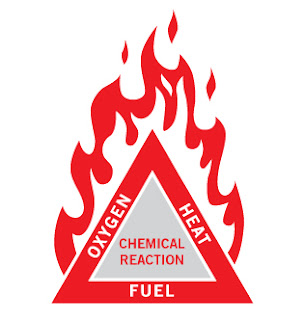
FIRE: Introduction

ALL ABOUT FIRE  Fire is the most common serious hazard that one faces in an industry or residential complex. While proper procedure ...