Showing posts with label MECHANICAL ENGG.. Show all posts

Tuesday, 31 October 2017

FIRE: Introduction


ALL ABOUT FIRE 

Fire is the most common serious hazard that one faces in an industry or residential complex. While proper procedure and training can minimize the chances of an accidental fire, you must still be prepared to deal with it.
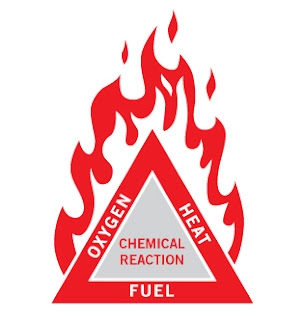
Fire Triangle is a tetrahedron, because there are four elements that must be present for a fire to exist. There must be oxygen to sustain combustion, heat to raise the material to its ignition temperature, fuel to support the combustion and a chemical reaction between the other three elements.
Remove any one of the four elements to extinguish the fire.

The concept of Fire Protection is based upon keeping these four elements separate.

Types of Fires:
Not all fires are the same. Different fuels create different fires and require different types of fire extinguishing agents.

Class A : Class A fires are fires in ordinary combustibles such as wood, paper, cloth, trash, and plastics. In simple terms, we can define Class A fire as the fire which occurs in SOLIDS. 


Class B: Class B fires are fires in flammable liquids such as gasoline, petroleum oil and paint. Class B fires do not include fires involving cooking oils and grease.  In simple terms, we can define Class B fire as the fire which occurs in LIQUIDS.


Class C: Class C fires are fires involving flammable gases such as propane and butane. Energized electrical equipment such as motors, transformers, and appliances also covers under this class.


Class D: Class D fires are fires in combustible metals such as potassium, sodium, aluminum, and magnesium.


Class K: Class K fires are fires in cooking oils and greases such as animals fats and vegetable fats.


Sunday, 4 June 2017

Old IES Syllabus-Mechanical Engineering

Syllabus for IES: Indian Engineering Services Examination

MECHANICAL ENGINEERING PAPER-I
(For both objective and conventional type papers)

1. Thermodynamics, Cycles and IC Engines: Basic concepts, Open and Closed systems. Heat and work. Zeroth, First and Second Law, Application to non-Flow and Flow processes. Entropy, Availability, Irreversibility and Tds relations. Claperyron and real gas equations, Properties of ideal gases and vapours. Standard vapour, Gas power and Refrigeration cycles. Two stage compressor. C-I and S.I. Engines. Pre-ignition, Detonation and Diesel-knock, Fuel injection and Carburation, Supercharging. Turbo-prop and Rocket engines, Engine Cooling, Emission & Control, Flue gas analysis, Measurement of Calorific values. Conventional and Nuclear fuels, Elements of Nuclear power production.


2. Heat Transfer and Refrigeration and Air conditioning: Modes of heat transfer. One dimensional steady and unsteady conduction. Composite slab and Equivalent Resistance. Heat dissipation from extended surfaces, Heat exchangers, Overall heat transfer coefficient, Empirical correlations for heat transfer in laminar and turbulent flows and for free and forced Convection, Thermal boundary layer over a flat plate. Fundamentals of diffusive and connective mass transfer, Black body and basic concepts in Radiation, Enclosure theory, Shape factor, Net work analysis. Heat pump and Refrigeration cycles and systems, Refrigerants. Condensers, Evaporates and Expansion devices, Psychrometry, Charts and application to air conditioning, Sensible heating and cooling, Effective temperature, comfort indices, Load calculations, Solar refrigeration, controls, Duct design.


3. Fluid Mechanics: Properties and classification of fluids, Manometry, forces on immersed surfaces, Center of pressure, Buoyancy, Elements of stability of floating bodies. Kinematics and Dynamics. Irrotational and incompressible. Inviscid flow. Velocity potential, Pressure field and Forces on immersed bodies. Bernoulli's equation, Fully developed flow through pipes, Pressure drop calculations,Measurement of flow rate and Pressure drop. Elements of boundary layer theory, Integral approach, Laminar and turbulent flows, Separations. Flow over weirs and notches. Open channel flow, Hydraulic jump. Dimensionless numbers, Dimensional analysis, Similitude and modelling. One-dimensional isentropic flow, Normal shock wave, Flow through convergent - divergent ducts, Oblique shock-wave,Rayleigh and Fanno lines.


4. Fluid Machinery and Steam Generators: Performance, Operation and control of hydraulic Pump and impulse and reaction Turbines, Specific speed, Classification. Energy transfer, Coupling, Power transmission, Steam generators Fire-tube and water-tube boilers. Flow of steam through Nozzles and Diffusers, Wetness and condensation. Various types of steam and gas Turbines, Velocity diagrams. Partial admission. Reciprocating, Centrifugal and axial flow Compressors, Multistage compression, role of Mach Number, Reheat, Regeneration,Efficiency, Governance.

MECHANICAL ENGINEERING PAPER - II
(For both objective and conventional type papers)

5. THEORY OF MACHINES: Kinematic and dynamic analysis of planer mechanisms. Cams. Gears and gear trains. Flywheels. Governors. Balancing of rigid rotors and field balancing. Balancing of single and multi cylinder engines, Linear vibration analysis of mechanical systems. Critical speeds and whirling of shafts Automatic controls.

6. MACHINE DESIGN :Design of Joints : cotters, keys, splines, welded joints, threaded fasteners, joints formed by interference fits. Design of friction drives : couplings and clutches, belt and chain drives, power screws.

Design of Power transmission systems : gears and gear drives shaft and axle, wire ropes.
Design of bearings : hydrodynamics bearings and rolling element bearings.

7. STRENGTH OF MATERIALS: Stress and strain in two dimensions, Principal stresses and strains, Mohr's construction, linear elastic materials, isotropy and anisotropy, stress-strain relations, uniaxial loading, thermal stresses. 

Beams :Bending moment and shear force diagram, bending stresses and deflection of beams. Shear stress distribution. Torsion of shafts, helical springs. Combined stresses, thick-and thin-walled pressure vessels. Struts and columns. Strain energy concepts and theories of failure.

8. ENGINEERING MATERIALS :Basic concepts on structure of solids. Crystalline materials. Detects in crystalline materials. Alloys and binary phase diagrams. Structure and properties of common engineering materials. Heat treatment of steels. Plastics, Ceramics and composite materials. Common applications of various materials.

9. PRODUCTION ENGINEERING :
Metal Forming : Basic Principles of forging, drawing and extrusion; High energy rate forming; Powder metallurgy.
Metal Casting : Die casting, investment casting, Shall Moulding, Centrifugal Casting, Gating & Riser design; melting furnaces.
Fabrication Processes : Principles of Gas, Arc, Shielded arc Welding; Advanced Welding Processes,
Weldability: Metallurgy of Welding.
Metal Cutting : Turning, Methods of Screw Production, Drilling, Boring, Milling, Gear Manufacturing,Production of flat surfaces, Grinding & Finishing Processes. Computer Controlled Manufacturing Systems-CNC, DNC, FMS, Automation and Robotics.Cutting Tools Materials, Tool Geometry, Mechanism of Tool Wear, Tool Life & Machinability; Measurement of cutting forces. Economics of Machining. Unconventional Machining Processes. Jigs and Fixtures. Fits and tolerances, Measurement of surface texture, Comparators Alignment tests and reconditioning of Machine Tools.

10. INDUSTRIAL ENGINEERING :
Production Planning and Control : Forecasting - Moving average, exponential smoothing, Operations, scheduling; assembly line balancing, Product development, Break-even analysis, Capacity planning,PERT and CPM.
Control Operations : Inventory control ABC analysis, EOQ model, Materials requirement planning. Job design, Job standards, Work measurement, Quality Management - Quality analysis and control.
Operations Research : Linear Programming - Graphical and Simplex methods, Transportation and assignment models. Single server queuing model. Value Engineering : Value analysis for cost/value.

11. ELEMENTS OF COMPUTATION :
Computer Organisation, Flow charting, Features of Common computer Languages - FORTRAN, d Base III, Lotus 1-2-3, C and elementary Programming.

GATE SYLLABUS FOR MECHANICAL ENGINEERING

Engineering Mathematics:

Linear Algebra:

Matrix algebra, Systems of linear equations, Eigen values and eigen vectors.
Calculus:
Functions of single variable, Limit, continuity and differentiability, Mean value theorems,
Evaluation of definite and improper integrals, Partial derivatives, Total derivative,
Maxima and minima, Gradient, Divergence and Curl, Vector identities, Directional
derivatives, Line, Surface and Volume integrals, Stokes, Gauss and Green's theorems.

Differential equations:
First order equations (linear and nonlinear), Higher order linear differential equations
with constant coefficients, Cauchy's and Euler's equations, Initial and boundary value
problems, Laplace transforms, Solutions of one dimensional heat and wave equations
and Laplace equation.

Complex variables:
Analytic functions, Cauchy's integral theorem, Taylor and Laurent series.
Probability and Statistics:
Definitions of probability and sampling theorems, Conditional probability, Mean, median,
mode and standard deviation, Random variables, Poisson, Normal and Binomial
distributions.

Numerical Methods:
Numerical solutions of linear and non-linear algebraic equations Integration by
trapezoidal and Simpson's rule, single and multi-step methods for differential equations.

Applied Mechanics and Design:

Engineering Mechanics:
Free body diagrams and equilibrium; trusses and frames; virtual work; kinematics and
dynamics of particles and of rigid bodies in plane motion, including impulse and
momentum (linear and angular) and energy formulations; impact.

Strength of Materials:
Stress and strain, stress-strain relationship and elastic constants, Mohr's circle for plane
stress and plane strain, thin cylinders; shear force and bending moment diagrams;
bending and shear stresses; deflection of beams; torsion of circular shafts; Euler's
theory of columns; strain energy methods; thermal stresses.

Theory of Machines:
Displacement, velocity and acceleration analysis of plane mechanisms; dynamic
analysis of slider-crank mechanism; gear trains; flywheels.

Vibrations:
Free and forced vibration of single degree of freedom systems; effect of damping;
vibration isolation; resonance, critical speeds of shafts.

Design:
Design for static and dynamic loading; failure theories; fatigue strength and the S-N
diagram; principles of the design of machine elements such as bolted, riveted and
welded joints, shafts, spur gears, rolling and sliding contact bearings, brakes and
clutches.

Fluid Mechanics and Thermal Sciences: 

Fluid Mechanics:

Fluid properties; fluid statics, manometry, buoyancy; control-volume analysis of mass,
momentum and energy; fluid acceleration; differential equations of continuity and
momentum; Bernoulli's equation; viscous flow of incompressible fluids; boundary layer;
elementary turbulent flow; flow through pipes, head losses in pipes, bends etc.

Heat-Transfer:
Modes of heat transfer; one dimensional heat conduction, resistance concept, electrical
analogy, unsteady heat conduction, fins; dimensionless parameters in free and forced
convective heat transfer, various correlations for heat transfer in flow over flat plates
and through pipes; thermal boundary layer; effect of turbulence; radiative heat transfer,
black and grey surfaces, shape factors, network analysis; heat exchanger performance,
LMTD and NTU methods.

Thermodynamics:
Zeroth, First and Second laws of thermodynamics; thermodynamic system and
processes; Carnot cycle. irreversibility and availability; behaviour of ideal and real
gases, properties of pure substances, calculation of work and heat in ideal processes;
analysis of thermodynamic cycles related to energy conversion.

Applications:

Power Engineering: 
Steam Tables, Rankine, Brayton cycles with regeneration and
reheat. I.C. Engines: air-standard Otto, Diesel cycles. Refrigeration and air-conditioning:
Vapour refrigeration cycle, heat pumps, gas refrigeration, Reverse Brayton cycle; moist
air: psychrometric chart, basic psychometric processes. Turbomachinery: Peltonwheel,
Francis and Kaplan turbines - impulse and reaction principles, velocity diagrams.

Manufacturing and Industrial Engineering:

Engineering Materials:

Structure and properties of engineering materials, heat treatment, stress-strain
diagrams for engineering materials.

Metal Casting:

Design of patterns, moulds and cores; solidification and cooling; riser and gating design,
design considerations.

Forming:
Plastic deformation and yield criteria; fundamentals of hot and cold working processes;
load estimation for bulk (forging, rolling, extrusion, drawing) and sheet (shearing, deep
drawing, bending) metal forming processes; principles of powder metallurgy.

Joining:
Physics of welding, brazing and soldering; adhesive bonding; design considerations in
welding.

Machining and Machine Tool Operations:
Mechanics of machining, single and multi-point cutting tools, tool geometry and
materials, tool life and wear; economics of machining; principles of non-traditional
machining processes; principles of work holding, principles of design of jigs and fixtures

Metrology and Inspection:
Limits, fits and tolerances; linear and angular measurements; comparators; gauge
design; interferometry; form and finish measurement; alignment and testing methods;
tolerance analysis in manufacturing and assembly.

Computer Integrated Manufacturing:
Basic concepts of CAD/CAM and their integration tools.

Production Planning and Control:
Forecasting models, aggregate production planning, scheduling, materials requirement
planning.

Inventory Control:
Deterministic and probabilistic models; safety stock inventory control systems.

Operations Research:
Linear programming, simplex and duplex method, transportation, assignment, network
flow models, simple queuing models, PERT and CPM.

Thursday, 1 June 2017

B.Tech Admissions in BSA Crescent University, Chennai, India


B.S. Abdur Rahman University, Vandalur, Chennai-600 048, (formerly B.S. Abdur Rahman Crescent Engineering College) has been established under section 3 of the UGC Act 1956. The University is located in the outskirts of Chennai city on the G.S.T. Road, (Chennai-Trichy National Highway) 7 km from Tambaram and 2 km from Vandalur Railway Station and 17 km from the International Airport. Being adjacent to the Arignar Anna Zoological Park, it is easily accessible by city buses.
B.S. Abdur Rahman Crescent Engineering College, which has now been upgraded as B.S Abdur Rahman University, was an institution acclaimed throughout India for its quality in teaching and research. Being one of the largest engineering institutions in India, it lays emphasis on innovative research, investment in high-quality facilities and first-rate infrastructure. By making use of the latest technologies and quality teaching, the college is able to offer a wide choice of interdisciplinary degrees in engineering which has enabled students to gain accolades in the global level. It is one of the few institutions with all the UG and PG programmes approved by AICTE and accredited by the National Board of Accreditation. This has been upgraded to university status with a view to keep academic in pace with development in industry. Modern hostel facilities are available for men and women students separately within the University campus.

Students are imparted knowledge and provided ample opportunities to test their knowledge in real-time industrial situations and during this pursuit, their character traits are shaped and fine-tuned to enable them to initiate, compete, lead and share and become a good human being.
The placement record of the institution has been remarkable and most students chart their careers well before their graduation. All the graduates from its portals either occupy prestigious positions in multinational companies or join institutions of higher learning in India and abroad. Some of the graduates turn entrepreneurs with the guidance of Entrepreneurship Development Cell and Industry-Institute Partnership Cell.


Course Name: B.Tech

For admissions please visit : BSA Crescent University Admissions

For details about institution please visit: BSA University Chennai


Admission notification in Pawan Hans Limited, India


Institute Name: Pawan Hans Helicopter Training Institute (PHTI), Mumbai

Course Name: Aircraft Maintenance Engineering/ B.Sc( Aeronautics)

Course Duration: Three Years ( Six Semesters)

Education Qualification: 10+2 in Science/ Diploma in Engineering

Last date for application: July 15, 2017

For online application please visit: Pawan Hans PHTI Admissions

For details about Pawan Hans Limited please visit: Pawan Hans Limited

B.Tech/ M.Tech/Phd admissions in K.R.Mangalam University, Gurgaon, India


K.R. Mangalam University, Haryana is a State Private University established under Haryana Private Universities Act and is empowered to award degrees under section 22 of the UGC act, 1956. pread over 26 acres, the KRM University campus is meticulously designed with special emphasis on conserving nature.  KRMU is located in a wonderful location with magnificent view of Arawali hills. The campus is beautiful and has all facilities and resources for a conducive learning environment.

Course Name: B.Tech/ M.Tech/ PHd

For online application please visit: KR Mangalam online application

For details about institution please visit: KR Mangalam University

For more PG admissions please visit: PG Admissions


Phd & M.Phil Admissions in KL University, Vijaywada, India


The Koneru Lakshmaiah Charities was established as a trust in the year 1980 with its official address at Museum road, Governorpet, Vijayawada, Andhra Pradesh – 520 002 and started KL College of Engineering in the Academic year 1980-81. The trust was converted into a Society by the name Koneru Lakshmaiah Education Foundation in the year 1996. The KL College of Engineering has attained autonomous status in the year 2006 and in February 2009, the Koneru Lakshmaiah Education Foundation Society was recognized as Deemed to be University. In short Koneru Lakshmaiah Education Foundation is named as K L University.
Vijayawada is located on the banks of river Krishna in the state of Andhra Pradesh and has been historically a cultural, political and educational center. The city is well connected by National Highway and Rail with Chennai (440 km), Hyderabad (275 km), Vizag (385 km) and is a central junction for trains running from North to South India. Daily flights operate from Hyderabad and Bangalore.

K L University is situated in a spacious 100-acre campus on the banks of Buckingham Canal of river Krishna, eight kilometers from Vijayawada city. Built within a rural setting of lush green fields, the institute is a virtual paradise of pristine nature and idyllic beauty. The campus has been aptly named "Green Fields" and the splendid avenue of trees and gardens bear testimony to the importance of ecology and environment. The campus ambience is most befitting for scholastic pursuits. The University has been situated on a built up area of around 15, 00, 000 S. Ft.
Course Name: Phd in Engineering
Last date for application: June 10, 2017
Entrance Test Date: June 18, 2017
Interview Date: June 19, 2017
For online application please visit: KL University Phd Admissions
For details about university please visit: KL University
For more admissions please visit: PG Admissions

Tuesday, 23 May 2017

Pumps: A brief Introduction & Classification


PUMPS: A Brief Introduction & Classification


The hydraulic machines, which convert the mechanical energy into hydraulic energy, are called pumps. The hydraulic energy is in the form of pressure energy.

Most process in industries involves the transportation of liquids, or their transfer from one level of pressure or static energy to another. The pump is the mechanical means for achieving this transport or transfer, and thus becomes an essential part of all processes.


Classification of Pumps: Pumps may be classified on the basis of application they serve, the material from which they are constructed, the liquid they handle, and even their orientation in the space.


Saturday, 20 July 2013

HR Interview Questions and Answers

1. Assuming that you are selected, what will be your strategy for next 60 days?

If I am selected for this position, I’ll use my initial 60 days in understanding my role carefully in terms of the contribution to the business and increasing the overall profitability. I’ll sit with my line manager and other juniors to understand what has already been done and what its impact has been. From there on, I’ll formulate my strategy to growth in close conjunction with managers and see that it is properly implemented.

2. How would you improve upon our product/ company?

Since I’d be coming from an altogether new environment, I am bound to possess a new perspective towards everything here including the company, product, customers, environment, strategy etc. This will enable me to constructively question things which anyone else here might not do. This will help in improving the things and making the product & company better.
Having worked closely with product development team I understand how the research for product development is carried out and how is customer requirement analysed; I’d be able to provide a value addition there too.

3. Don’t you think, you are overqualified for this position?

You might feel that I possess more degrees than you require for this position. But, I believe that I grow everyday when I talk to my staff, customers and superiors. So, basically the learning process continues through out the life – I don’t think I am over qualified.

4. Have you ever had a problem with your peer? Can you give us an example?

Yes, it happened once. I was quite friendly with a colleague of mine from the other department. While talking to him during the lunch hour, I casually told him about the new marketing strategy that the marketing team was thinking about. He mentioned it to his boss and that caused a lot of confusion between the two departments. This taught me a lesson that you must not discuss any departmental strategies with anyone from other department unless you have been authorised by your boss.

5. I see, there’s some gap in your work history. Why?

Yes, I was feeling exhausted after years of non-stop work. So, I decided to take a break and spend some time with my family on a rejuvenating vacation. I am happy to have returned fully recharged.

6. Can you tell us something about your previous boss?

All my bosses possessed some skills worth learning. I have always tried to learn something new from them including my previous boss.

7. Is there anything that you do not like about your last or current job?

I was quite enthusiastic while joining my last job. Towards the end, the number of challenges and opportunity to grow further started diminishing. A challenge loving and growth oriented person like me doesn’t enjoy this.

8.Have there been instances, when your decision was challenged by your colleague or manager?

Yes, there have been many such instances. I like people who challenge my decisions rather than following me blindly. This keeps me ensured that I am surrounded by thinking brains rather than just a set of dumb followers.
When someone challenges your decisions, you are bound to rethink over it and the chances of reaching the best option are brighter.

9. If you are allowed to change one thing about your last job, what would it be?

I have been working at a senior level since last many years. These roles have always needed me to make real time decisions. Sometimes the facts, figures and other information in real time cases are not complete & still we have to make a decision. In such cases, there exists a probability of making inaccurate decisions.

Knowing this, I usually run down my old decisions to see the outcome. It makes sure that I don’t repeat a mistake ever again in future. While carrying out one such exercise, I realised that the product promotion strategy that I recommended would have been different, if I had had the complete data and figures but there was no way to get them in real time.

10. How long can you commit to work with us?

I like new challenges and a chance to grow. As long I keeping getting these, I don’t think I’ll need to switch over. I’d like to believe that this relationship lasts for many years. However, I haven’t set a time limit as such.


What jobs can you do with a mechanical engineering degree?

Mechanical engineering graduates are sought by employers in almost all sectors of the engineering industry. These include:
  • Aerospace industry – researches, designs, manufactures, operates and maintains aircraft
  • Automotive industry – designs, manufactures, distributes and markets motor vehicles
  • Chemical industry – covers oil companies, chemicals manufacturers and the businesses that support them (e.g to build new plants or develop new process technologies)
  • Construction industry – designs and builds infrastructure, buildings and buildings services (eg heating and ventilation)
  • Defence industry – provides equipment, support and services for the armed forces and national security
  • Electronics industry – designs and manufactures components and complete equipment for sectors from automotive to medicine and the military
  • Fast moving consumer goods industry – manufactures products such as household cleaning items, personal hygiene goods and convenience foods
  • Marine industry – develops and helps operate vessels
  • Materials and metals industry – activities include developing new materials and manufacturing components or end products
  • Pharmaceuticals industry – develops and manufactures drugs
  • Rail industry – designs, constructs, manages and maintains rail system components from trains and tracks to electrical power systems and train control systems
  • Utilities industry – helps supply power, water, waste management and telecoms.

CAREER PROSPECTS OF A MECHANICAL ENGINEER


After doing B.Tech/B.E. in Mechanical Engineering, students can find large number of opportunities to build in a long term rewarding career.  Ample of jobs are available for Mechanical Engineers both in private and public sector companies.

The student studies the principles of mechanics and physics to apply for design, production and maintenance of various mechanical devices while doing B.Tech/B.E. in Mechanical Engineering. The domain and type of firm decides the job prospects for the mechanical engineers. In the present scenario the industrial sector is flourishing at a great pace. This provides a lot of job opportunities for the mechanical engineers. The candidates after completing B.Tech/B.E. in Mechanical Engineering find placement in various manufacturing and production firms.
The various industries in which a candidate after completing B.Tech/B.E. in mechanical engineering can work are listed below.
  • Automobile
  • Aerospace
  • Chemical
  • Communication
  • Computers
  • Steel
  • Power generation industries
  • Paper
  • Petroleum refineries
  • Mining Industries
  • Aluminium 
  • Agriculture farm machineris
  • FMCG
  • Manufacturing of components & MANY MORE
Government Career after B.Tech in Mechanical
The candidates can write various government entrance examinations after completing B.Tech in Mechanical engineering. Some of the governments examinations are that which are conducted by State PSCs, SSC, UPSC, Postal departments, Railway departments, etc. The professionals can even apply for various public sector bank officers’ examination. The aspirants can even write exams of Indian Air Force, defense sector, etc. Another option for the professionals is to take up jobs in various government universities and colleges
The aspirants find a lot of opportunities in various public sector firms. Some of the public sector firms recruiting mechanical engineers are listed below.
  • ONGC
  • DRDO
  • SAIL
  • NTPC
  • VSSC
  • ISRO
  • IOCL
  • HPCL
  • BPCL
  • EIL
  • NMDC
  • MECON
  • HECL
  • NPCIL
  • BHEL
  • BPCL
  • DAE
  •  Many more
As a fresher, the professionals can join as Junior Engineers. Gradually they can go up in positions of Assistant Executive Engineers and so on with experience.

Career in Private Sector after B.Tech in Mechanical

Private sector companies offer large number of opportunities for the mechanical graduates. The candidates can look for teaching jobs in various private engineering colleges. They can work as consultants in automobile, logistics, and transportation firms. Another option for the graduates is to work in IT firms like Infosys, Wipro, IBM, etc. The candidates can find variety of opportunities in power, mining, fertilizer sector as well.

Career Abroad after B.Tech in Mechanical

Mechanical engineers can find a large amount of opportunities overseas. Many industries such as steel plants, oil and refineries, electronics, automobile, etc recruit mechanical engineers in foreign countries. Better remuneration can be attained in many of the developed countries by taking a master’s degree.
The candidates can complete their post graduate degree in mechanical engineering and look for jobs. This is will increase their job prospects as well as remuneration. The candidates can even join for research works in various laboratories.

FIRE: Introduction

ALL ABOUT FIRE  Fire is the most common serious hazard that one faces in an industry or residential complex. While proper procedure ...